As an Amazon Associate, I earn from qualifying purchases. This does not affect the price you pay, but it may help support this site.
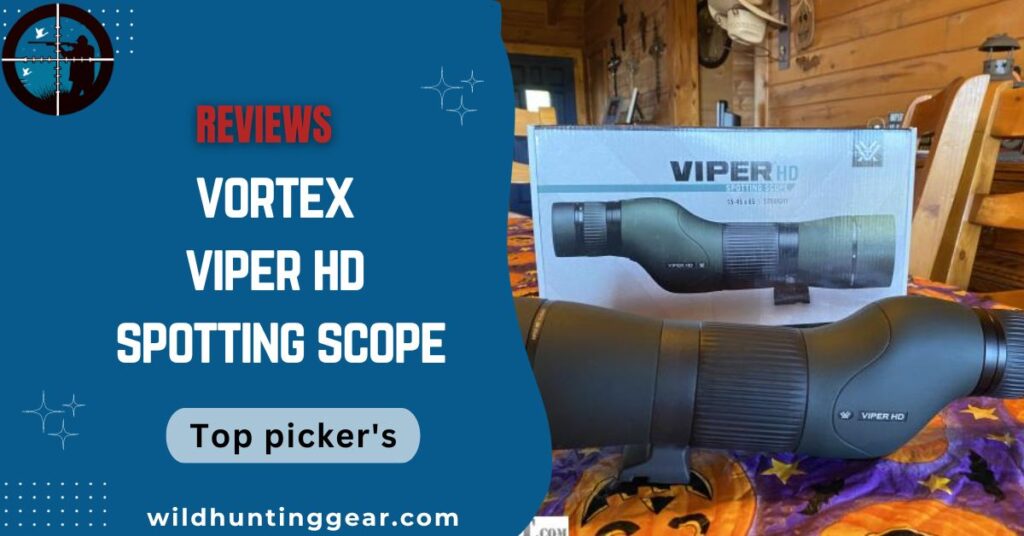
The Vortex Viper HD 20-60×85 is best for hunters, target shooters, birdwatchers, and long-range observers who want a bright 85mm spotting scope without paying Razor HD money. It is powerful, sharp in good light, strong in low light, and very usable on a tripod, but its 76.6 oz weight makes it less ideal for ultralight backpack hunting.
Perfect for Hunting, Outdoor Use, and Shooting
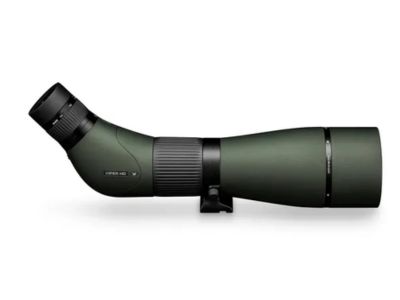
If you are looking for a serious mid-range spotting scope, the Vortex Viper HD 20-60×85 is one of the strongest options to consider. It combines sharp HD glass, a large 85mm objective lens, and useful 20-60x zoom, making it a solid choice for spotting fine details at longer distances.
Choosing the right spotting scope usually comes down to clarity, reach, weight, and budget. In this Vortex Viper HD 20–60×85 review, we will cover its optical performance, build quality, ease of use, pros and cons, and how it compares with the Vortex Diamondback HD and Razor HD, so you can decide whether it is the right scope before you buy.
Vortex Viper HD 20–60×85 Quick Specs
| Feature | Details |
| Product | Vortex Viper HD Spotting Scope |
| Magnification | 20–60x |
| Objective Lens | 85mm |
| Weight | 76.6 oz |
| Length | 17.5 in |
| Field of View | 101’–50′ @ 1000 yards |
| Eye Relief | 17.8–19.6 mm |
| Close Focus | 36 ft |
| Design | Angled spotting scope |
| Optical System | HD Optical System with XR™ Plus Lens Coatings |
| Build | Waterproof, fogproof, rubber armored, ArmorTek protected |
| Tripod Mount | Arca-Swiss compatible |
| Included Items | Ocular lens cover, objective lens cover, neoprene cover, lens cloth |
| Best For | Hunting, shooting, birdwatching, wildlife viewing |
| Best Use | Tripod glassing, range use, long-distance viewing |
| Main Advantage | Strong clarity, zoom, and value |
| Main Drawback | Heavier than smaller spotting scopes |
Vortex Viper HD Spotting Scope 20–60×85 Overview
The Viper HD is a mid-range spotting scope built for hunters, target shooters, birdwatchers, and anyone who spends time glassing distant terrain. It combines a 20–60x zoom range with an 85mm objective lens, HD (extra-low dispersion) glass, and Vortex’s XR anti-reflective lens coatings.
In practical terms, that combination is designed to deliver a bright, high-contrast image with minimal color fringing, even at the top of its zoom range something budget scopes typically struggle with once you push past 40x or so. The larger 85mm lens also means more light-gathering capacity, which matters most in early morning and late evening conditions, when animals are often most active and light is at a premium.
Watch a quick look at the Vortex Viper HD 20–60×85 in use:
Vortex builds the Viper HD to hold up outdoors: The argon purging and O-ring sealing help protect the scope from internal fogging and moisture in changing outdoor conditions, and the body is wrapped in rubber armor for grip and impact protection. ArmorTek coating on the exterior lens surfaces resists scratches, oil, and dirt a small detail that matters if the scope is going to live in a truck, a blind, or a backpack.
Vortex Optics Key Features
HD Glass and XR Coatings
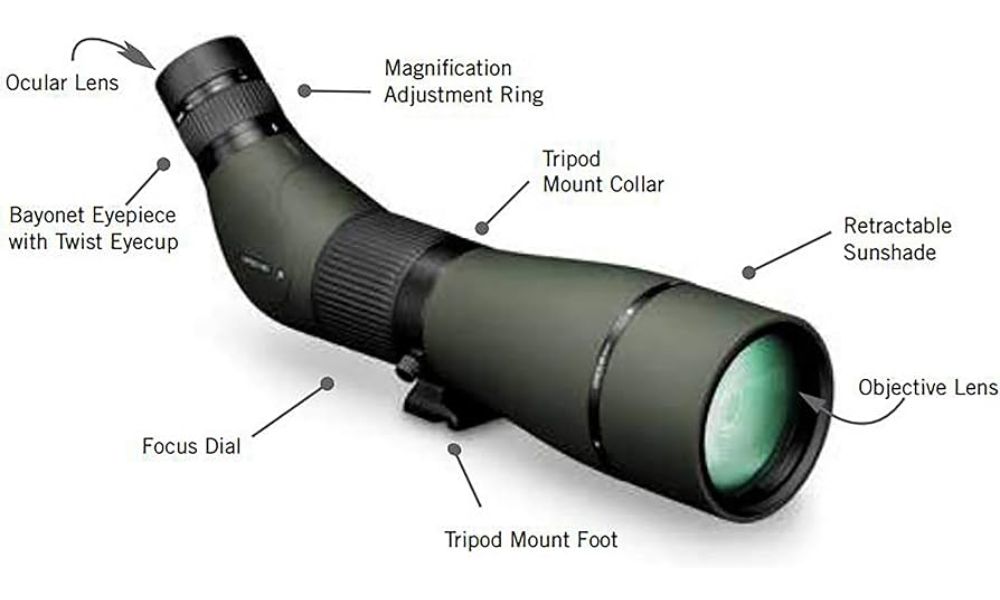
The “HD” in Viper HD refers to extra-low dispersion glass elements, which reduce chromatic aberration the color fringing that shows up around high-contrast edges in cheaper optics. Paired with Vortex’s XR anti-reflective coatings, which are applied to multiple lens surfaces to boost light transmission, the result is a scope built to stay sharp and bright across its full zoom range rather than degrading noticeably at higher magnifications, which is a common weak point in lower-tier scopes.
20–60x Zoom Range
This range gives you flexibility most single-purpose scopes don’t have. The lower end, 20x, is useful for scanning wide areas such as a hillside, field edge, or shoreline, while the top end, 60x, is better for confirming details on a specific subject. whether that’s judging antler points, reading a target, or identifying a bird species. Keep in mind that magnification above 40x on any spotting scope becomes noticeably harder to use handheld; a stable tripod is effectively required to get real value from the upper half of this zoom range.
85mm Objective Lens
The objective lens is the front lens that determines how much light the scope can gather. At 85mm, the Viper HD sits in the “large objective” category for spotting scopes, which is a direct trade-off: more light-gathering ability and better low-light performance, in exchange for more size and weight than a 65mm or 50mm scope. For anyone doing serious dawn or dusk glassing, that trade is usually worth it.
Helical Focus System
Rather than a simple focus ring, the Viper HD uses a helical (screw-type) focus wheel, which is generally regarded as offering finer, more controlled adjustments than a standard ring useful when trying to nail focus on a distant, partially obscured subject.
Weatherproofing and Build
O-ring sealing and argon gas purging are standard features on higher-quality spotting scopes, and the Viper HD includes both. Argon (rather than the more common nitrogen) is generally considered slightly more effective at preventing internal fogging across temperature swings. The rubber-armored housing adds a layer of protection against drops and knocks, which matters given how this scope is likely to be used in trucks, blinds, and rough terrain rather than on a shelf.
Sunshade and Eyecup
A pull-out sunshade extends from the front of the objective lens housing to reduce glare and stray light when glassing toward the sun or across bright, reflective terrain like snow or water. The eyecup is adjustable across multiple positions, which allows both eyeglass wearers and non-eyeglass wearers to find a comfortable eye relief distance without sacrificing field of view a detail that matters more than it sounds like during extended glassing sessions.
Angled vs. Straight Body Design
The Viper HD 20–60×85 is available in an angled body configuration, where the eyepiece sits at roughly a 45-degree angle relative to the main tube. This design is generally easier on the neck during long tripod-based sessions, since it allows users to look downward into the eyepiece rather than directly through it, and it makes sharing the view between people of different heights more practical without adjusting the tripod itself. A straight-body version is also offered for buyers who prioritize quick target acquisition or lower shooting positions over extended comfort.
Pros and Cons
Pros
- HD glass and XR coatings deliver noticeably better clarity and color accuracy than budget-tier scopes, particularly at higher magnification
- 85mm objective lens provides strong low-light performance for dawn and dusk glassing
- Fully waterproof and fogproof construction suited to real outdoor conditions
- 20–60x zoom range covers both wide-area scanning and fine detail confirmation
- Priced well below Vortex’s premium Razor HD line while retaining much of its core performance
Cons
- At roughly 4.75 lbs, it’s heavier than compact or mid-size scopes, which matters for anyone hiking long distances
- Requires a sturdy tripod to use effectively at higher magnifications not a realistic handheld option past 30–40x
- Costs more than Vortex’s own Diamondback HD line, which may be a better fit for casual or budget-conscious buyers
- Limited to standard finish options, with no expanded color or customization choices
Disclosure: As an Amazon Associate, I earn from qualifying purchases. This does not affect the price you pay, but it may help support this site.
Case Studies and Real-World User Examples
The following examples are based on public forum discussions from hunters and outdoor users. They should be treated as real-world community feedback, not verified customer reviews.
Case Study 1: The Preseason Scouting Hunter
Catahoula owned a Viper 20–60×80 angled spotting scope and used it for preseason scouting. His feedback was positive, saying it worked well for its build quality and Vortex’s mid-range price point. He also had no major complaints about the scope during his use.
This is a strong example of where the Viper HD fits best. For hunters who glass from fixed points, scout open country, check fields, or observe animals before the season, the Viper gives enough reach and clarity to be useful without stepping into premium Razor HD pricing. It is especially practical when used from a tripod rather than carried all day in an ultralight backpack setup.
Case Study 2: The Backpack Hunter Who Prioritized Weight
Ram94 had used an older 80mm Viper HD for several years but later moved to a smaller Athlon Ares 65mm. His main reasons were weight and pack space. He said the smaller scope saved almost two pounds and was easier to carry in the field.
This is important for buyers who plan to hike long distances. The Viper HD 20–60×85 offers strong magnification and a large objective lens, but it is not the best choice for ultralight backpack hunting. If the buyer’s main goal is maximum portability, a smaller 65mm spotting scope may be easier to live with. But for truck-based hunting, range use, or fixed glassing points, the Viper’s larger size can still make sense.
Case Study 3: The Buyer Comparing Viper HD vs Razor HD
yeti_man compared the Viper with a Razor 11–33×50. He felt the Viper was a nice piece of glass, but also said it was bulkier and not as sharp or crisp as the Razor. This is useful because it clearly shows where the Viper sits in Vortex’s lineup.
The Viper HD is best understood as a serious mid-range spotting scope. It is a step above entry-level glass, but it is not meant to fully replace the Razor HD line. Buyers who want strong clarity, solid low-light performance, and good value may be happy with the Viper. Buyers who want the sharpest and cleanest image possible should consider the Razor HD instead.
Real-World Takeaway
These case studies show that the Vortex Viper HD is best for hunters, shooters, and wildlife viewers who want dependable mid-range performance without paying premium Razor HD prices. It works especially well for tripod-based glassing, preseason scouting, range use, and fixed-point observation. However, buyers should keep its weight in mind if they plan to hike long distances or build an ultralight hunting setup.
Who Should Consider the Vortex Viper HD 20–60×85?
Hunters
Hunters who spend time glassing open terrain ridgelines, fields, canyon country are the scope’s clearest match. The larger objective lens and HD glass are specifically useful during the low-light hours when big game is most active, and the zoom range covers both wide scanning and detailed confirmation once an animal is spotted.
Target Shooters and Range Users
Target shooters and range users benefit from being able to confirm hits at distance without walking downrange after every group, which speeds up range sessions and saves wear on paper or steel targets.
Birdwatchers and Wildlife Observers
Birdwatchers and wildlife observers who want to resolve fine detail feather patterns, distant behavior from a fixed position will find the zoom range and glass quality well suited to stationary, tripod-based observation.
Backpackers and Ultralight Hikers
Backpackers and ultralight hikers are the clearest mismatch. At nearly 5 lbs, this scope adds meaningful weight to a pack, and its size makes it awkward for anyone prioritizing minimal gear. A smaller Vortex scope, like the compact Viper HD 15-45×65, would be a better fit for that use case.
Casual or First-Time Buyers
Casual or first-time buyers who just want an occasional-use scope for backyard birdwatching may find the Diamondback HD a more sensible starting point, both in price and portability, before stepping up to something like the Viper HD.
Vortex Viper HD vs Diamondback HD vs Razor HD: Which One Should You Buy?
If you are comparing Vortex spotting scopes, the Vortex Viper HD 20–60×85 sits between the budget-friendly Diamondback HD and the premium Razor HD. It offers more reach and stronger low-light performance than the Diamondback HD, while costing less than the Razor HD.
| Spotting Scope | Best For | Clarity & Low-Light | Weight & Portability | Price Level | Best Buying Reason |
|---|---|---|---|---|---|
| Vortex Viper HD 20–60×85 | Hunters, shooters, serious wildlife viewers | Sharp HD glass with strong low-light performance | Heavier at 76.6 oz; best with a tripod | Mid-range | Best balance of power, clarity, and value |
| Vortex Diamondback HD 16–48×65 | Budget buyers and casual users | Good clarity for the price | Lighter at 49.8 oz and easier to carry | Budget-friendly | Best cheaper alternative to the Viper HD |
| Vortex Razor HD 27–60×85 | Premium buyers and long-range users | Best optical performance in this comparison | Large but still field-ready at 65.6 oz | Premium | Best image quality if budget is not a concern |
FAQ’s
Final Verdict
The Vortex Viper HD 20–60×85 is built for buyers who need real reach and clarity not casual, occasional use. Its combination of HD glass, a large 85mm objective lens, and durable, weatherproof construction makes it a strong option for hunters, shooters, and dedicated wildlife observers who will actually put its full zoom range and low-light capability to use.
It isn’t the lightest or cheapest option in Vortex’s lineup, and it isn’t the optical equal of the Razor HD but for buyers looking for a genuine step up from entry-level glass without paying premium prices, it represents one of the stronger value propositions in Vortex’s spotting scope range.