The Hawke Vantage LRF 400 is a compact laser rangefinder designed for hunters, bowhunters, and airgun shooters who need reliable distance measurements without investing in expensive long-range equipment. With 6× magnification, a maximum measuring range of 400 metres (437 yards), and practical features such as Hunt Mode, Rain Mode, and horizontal distance measurement, it offers a useful combination of portability and functionality.
“If you’re comparing other brands before buying, our Vortex rangefinder review and Bushnell rangefinder review offer additional options to consider.”
But how accurate is the Hawke Vantage LRF 400 in real-world conditions? Can it measure smaller targets consistently, and is it still worth buying compared with newer Hawke rangefinders?
In this Hawke Vantage LRF 400 review, we’ll examine its specifications, independently reported accuracy, hunting and archery performance, common limitations, and overall value. If you’re considering alternatives from other brands, our Bushnell V5 vs V6 rangefinder comparison offers another perspective on choosing a rangefinder.
Hawke Vantage LRF 400: Quick Verdict
A compact rangefinder for hunting and target shooting.

“As an Amazon Associate, I earn from qualifying purchases.”
The Hawke Vantage LRF 400 is a practical choice for hunters, bowhunters, and airgun shooters who need a compact rangefinder for short- to medium-distance measurements. Its 6x magnification, 400m (437-yard) maximum range, and horizontal distance measurement make it useful for woodland hunting, field archery, and general outdoor ranging.
If you’re comparing options for hunting, see our guide to the best rangefinder for hunting.
What we like:
- 6x magnification with a compact, lightweight design
- 400m (437-yard) maximum measuring range
- Horizontal Distance and Angle modes for elevated targets
- Hunt and Rain modes for challenging outdoor conditions
- Straightforward controls suitable for beginners
What could be better:
- The black LCD can be difficult to read against dark backgrounds.
- Small or poorly reflective targets may require repeated measurements.
- The maximum range is limited compared with newer long-range models.
- It lacks advanced ballistic calculation features.
Our verdict: The Vantage LRF 400 is worth considering for airgun shooting, archery, and shorter-range hunting, especially if you find it at a competitive price. However, buyers who need longer-range measurements or an illuminated display should compare newer alternatives.
Hawke Vantage LRF 400 Specifications
The Hawke Vantage LRF 400 (model 41200) combines 6x magnification, fully multi-coated optics, and a maximum measuring range of 400 metres (437 yards). Its compact design, angle measurement functions, and dedicated Rain and Hunt modes make it suitable for hunting, archery, airgun shooting, and general outdoor distance measurement. If you’re comparing affordable alternatives, explore our guide to the best hunting rangefinder under $200.
A few practical features make the Vantage 400 stand out from many budget rangefinders:
Here’s a quick look at the specs so you know exactly what you’re getting before diving deeper into performance.
Here’s a breakdown of its specifications.
| Feature | Specification |
|---|---|
| Brand | Hawke Optics |
| Model | Vantage LRF 400 |
| Product Number | 41200 |
| Magnification | 6x |
| Objective Lens | 21mm |
| Measuring Range | Approximately 6–400m / 7–437 yards |
| Manufacturer-Stated Accuracy | ±1 metre (approximately ±1.1 yards) |
| Field of View | 140m at 1,000m / 420ft at 1,000 yards |
| Optical Coating | Fully multi-coated |
| Prism | BK7 roof prism |
| Display | Non-illuminated LCD |
| Measuring Modes | Standard Distance, Horizontal Distance, Angle, Rain, Hunt |
| Additional Function | Continuous scanning |
| Eye Relief | 18mm |
| Battery | One CR2 3V lithium battery |
| Water Resistance | IPX5 water-resistant |
| Fog Resistance | Nitrogen-filled and fogproof |
| Dimensions | Approximately 3.8 × 2.9 × 1.4 inches |
| Weight | Approximately 170g / 6oz |
| Operating Temperature | -10°C to 40°C (14°F to 104°F) |
What these specifications mean: The Vantage LRF 400 prioritizes portability and straightforward distance measurement over extreme long-range capability. Its 6x optics and wide field of view help users locate objects, while Horizontal Distance and Angle modes provide useful measurements on sloping terrain.
The advertised 400m range represents the maximum stated measuring capability, not a guarantee that every small or poorly reflective object can be measured at that distance.
Key Features of the Hawke Vantage 400
- 6x Optical Magnification with 21mm Objective Lens – Gives you enough zoom to identify targets clearly at normal hunting,archery, and airgun distances without making the image too shaky.
- 400m / 437-Yard Maximum Range – Offers solid reach for short-to-mid-range hunting, bowhunting, airgun shooting, and casual golf use.
- LCD Display – Provides a simple in-view readout for distance and mode information, though it is not as premium as an OLED display.
- Horizontal Distance Mode – Shows the equivalent flat-ground distance, which is useful when shooting from a treestand or across uneven terrain.
- Angle Compensation – Helps account for uphill and downhill shots, making it valuable for bowhunters and hillside hunters.
- Rain Mode – Helps ignore interference from raindrops, with best results when the target is more than 33 yards / 30m away.
- Hunt Mode – Helps ignore interference from grass, brush, or small obstacles between you and the target.
Hawke Vantage LRF 400 vs Similar Rangefinders
The Hawke Vantage LRF 400 competes with other budget-friendly Hawke rangefinders designed for hunting and outdoor use. Comparing features like range, magnification, and shooting modes helps you choose the right model based on your needs.
“For more model-specific comparisons, you can also read our Halo CL300 rangefinder review, Halo XL 600 review, and Halo XR 700 review.”
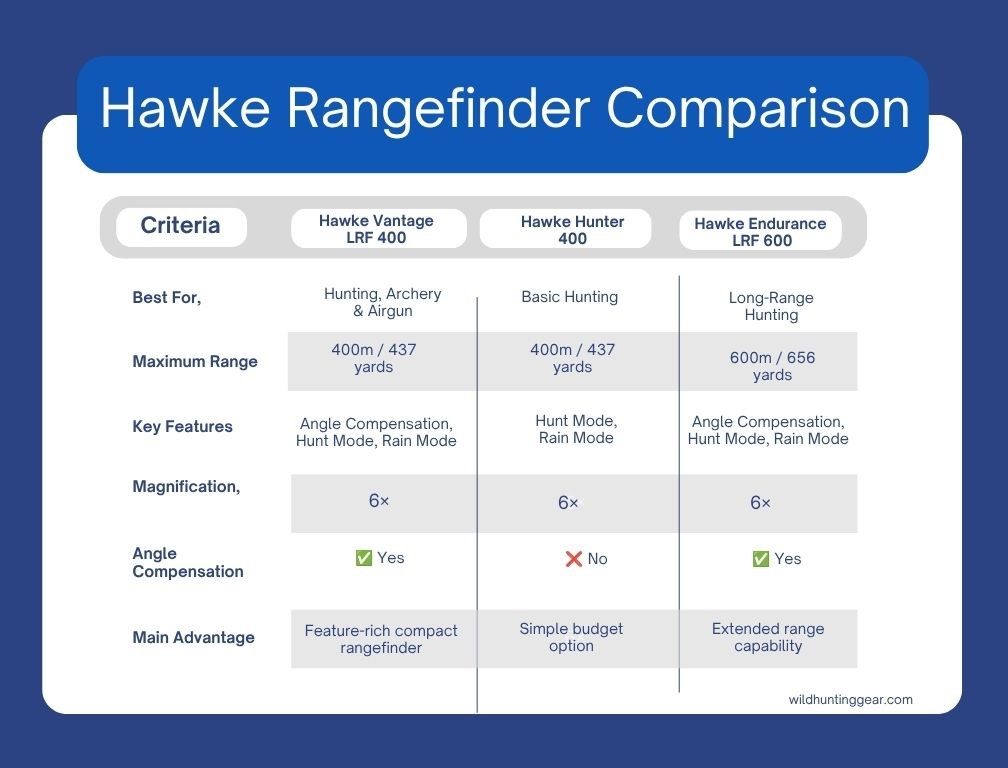
For most hunters and bowhunters, the Hawke Vantage LRF 400 offers a balanced combination of range, useful modes, and portability. If you need more distance, the Endurance LRF 600 may be a better option, while the Hunter 400 is better suited for users who want a simpler setup.
Hawke Vantage LRF400 Accuracy and Real-World Performance
The Hawke Vantage LRF 400 offers a manufacturer-stated maximum measuring range of 400 metres (437 yards), but how accurately does it perform at typical hunting, archery, and airgun distances?
Its real-world performance depends on more than the advertised range. Target size, reflectivity, surrounding obstacles, weather, and how steadily the device is held can all influence the reliability of a reading.
Fortunately, independent testing provides useful insight into what buyers can reasonably expect from this compact Hawke laser rangefinder.
Independent Accuracy Testing: What the Results Show
In an independent Airgun World review, reviewer Mark Camoccio tested the Hawke Vantage LRF400 at typical airgun distances and against selected targets several hundred yards away.
At distances up to 60 yards, he reported measurements within approximately one yard of the expected distance. At longer distances, readings generally remained within a couple of yards on the targets tested.
These results suggest the Vantage LRF400 can provide dependable distance measurements in suitable conditions, particularly at ranges commonly encountered in airgun shooting and field archery.
However, these figures come from an independent review of one unit. They should not be interpreted as guaranteed performance across every target, weather condition, or individual device.
Accuracy at 20–60 Yards
For airgun shooters and archers, consistent measurements at shorter distances can be more useful than an exceptionally high maximum-range specification.
The Vantage LRF400’s 6x magnification helps users identify objects and position the aiming indicator more precisely.
The independent testing results are encouraging for applications within approximately 60 yards, where accurate distance information can be especially valuable.
For greater confidence, take more than one reading when measuring a small object or a target surrounded by vegetation.
Performance at 100–150 Yards
At 100–150 yards, the Hawke Vantage LRF400 is operating comfortably within its advertised maximum measuring range.
However, that does not mean every target will produce an equally reliable measurement.
Larger objects, such as trees or broad reflective surfaces, are generally easier to range than small, dark, or irregular objects.
The independent reviewer also reported successful measurements on selected targets several hundred yards away, although performance at every intermediate distance was not separately documented.
Practical takeaway: The Vantage LRF400 can be useful beyond typical airgun distances, but successful ranging still depends on the target and conditions.
Can the Hawke Vantage LRF400 Measure Small Targets?
Small-target measurement is an important limitation to understand before buying.
Thin branches, small target faces, and poorly reflective objects can be difficult for a handheld rangefinder to isolate.
The laser may return a reflection from the background or another nearby object rather than the intended target.
Mark Camoccio encountered difficulty with certain small targets during his review and recommended measuring a larger nearby object when suitable.
To improve reliability:
- Hold the rangefinder as steadily as possible.
- Aim at a clearly visible, unobstructed object.
- Take multiple readings to check consistency.
- Use a larger nearby object only when it is genuinely at a comparable distance.
- Avoid treating an inconsistent reading as confirmed.
Low-Light and Weather Performance
The Hawke Vantage LRF400 uses an LCD display with black characters, rather than an illuminated OLED display.
While the optical system can still be used under reduced lighting, reading the display against dark vegetation or heavily shaded backgrounds may be difficult.
The rangefinder also includes Rain Mode and Hunt Mode to help reduce certain types of interference.
Rain Mode is intended to reduce interference from nearby rain reflections when measuring targets beyond approximately 33 yards (30 metres). Hunt Mode is designed for situations where foreground vegetation may interfere with the intended reading.
Neither mode guarantees successful measurements through heavy rain, dense foliage, or other substantial obstructions.
For users who regularly range targets in dim conditions, a model with an illuminated display may offer better visibility.
Real-World Accuracy: Final Assessment
Based on independent published testing, the Hawke Vantage LRF 400 performs credibly at typical airgun distances, with useful ranging capability extending to more distant targets under suitable conditions.
Its strengths are practical short- and medium-distance measurement, compact construction, and straightforward operation.
Its limitations become more noticeable when measuring very small objects, working around vegetation, or reading the display against dark backgrounds.
For buyers who mainly need accurate distance information at ordinary outdoor ranges, the Vantage LRF400 remains a reasonable option to consider. However, its 400-metre maximum specification should not be mistaken for guaranteed performance on every type of target.
Hawke Vantage LRF 400 Key Features Explained
The Hawke Vantage LRF 400 combines a 6x optical system, multiple distance-measuring modes, and a lightweight design in a compact handheld device. Its features are especially useful for hunters, airgun shooters, and field archers who need practical distance information in different outdoor conditions.
Here’s how its main features work and where they can be useful.
1. 6x Magnification and 21mm Objective Lens
The Vantage LRF 400 uses 6x magnification and a 21mm objective lens to help users identify distant objects and position the aiming indicator.
The optical system also features fully multi-coated lenses designed to reduce reflections and improve light transmission.
Six-power magnification provides a useful balance between viewing distant objects and maintaining a manageable field of view. However, hand movement can still make it difficult to hold the aiming indicator steady on very small targets.
For users who frequently observe distant scenery rather than simply measure distances, dedicated binoculars may be more practical. Our Hawke binoculars review explores another category of Hawke optics.
2. 400m (437-Yard) Measuring Range
The Hawke Vantage LRF 400 has a maximum advertised measuring range of 400 metres (437 yards), making it suitable for many short- and medium-distance outdoor applications.
However, maximum measuring range and reliable target acquisition are not the same thing.
A large, reflective object may be easier to measure than a small, dark object at the same distance. Weather, vegetation, target shape, and the steadiness of the device can also influence results.
For ordinary field use, the advertised range should be treated as an upper measurement limit rather than a guarantee for every target.
3. Horizontal Distance Mode
Horizontal Distance mode helps users understand the difference between direct line-of-sight distance and horizontal distance when measuring an object above or below their position.
For example, an object measured at 50 yards along a 30-degree angle has a horizontal distance of approximately 43.3 yards.
This information can be useful for field archery, surveying outdoor layouts, or checking distances across sloping ground.
However, horizontal distance is not a complete ballistic solution. The device does not automatically calculate every factor influencing a projectile’s trajectory.
4. Angle Measurement
Angle Mode provides information about the inclination between the observer and the measured object.
It can be useful when measuring objects positioned uphill or downhill, especially on uneven terrain.
The distinction is straightforward:
- Line-of-sight distance: The direct distance from the rangefinder to the object.
- Horizontal distance: The horizontal component of that distance.
- Angle: The inclination between the line of sight and the horizontal plane.
Together, these measurements give users a clearer understanding of object position and distance.
5. Hunt Mode
Hunt Mode is designed to help reduce interference from certain foreground objects when measuring a more distant target.
For example, grass, light brush, or small branches may reflect a laser signal before it reaches the intended object.
Hunt Mode can help in some of these situations by prioritizing a more distant return.
However, it cannot measure through solid objects or guarantee an accurate reading when dense vegetation completely obstructs the intended target.
For best results, choose a clear line of sight whenever possible.
6. Rain Mode
Rain Mode is intended to reduce interference from nearby rain reflections.
Published product information associates this function with measurements beyond approximately 30 metres (33 yards).
This can be helpful when light rainfall creates interference during outdoor ranging.
However, heavy precipitation, fog, and poor visibility may still prevent accurate measurements. Rain Mode should not be interpreted as protection against every weather-related limitation.
7. LCD Display and Simple Controls
The Vantage LRF 400 features a non-illuminated LCD display that shows distance measurements and operating information.
The display is straightforward to use, but black characters may be harder to distinguish against dark vegetation or shaded backgrounds.
The rangefinder uses a simple two-button control arrangement for activating measurements and selecting operating modes.
This uncomplicated layout makes the device approachable for beginners who prefer basic controls over complex menu systems.
8. Compact, Weather-Resistant Design
Weighing approximately 170 grams (6 ounces), the Vantage LRF 400 is lightweight enough for convenient handheld use.
Its compact housing is practical for carrying in a protective pouch or outdoor equipment bag.
Published product specifications describe water-resistant and fog-resistant construction, although users should follow the manufacturer’s instructions regarding exposure to rain, moisture, and storage.
Water resistance does not mean a device should be submerged.
“Hunters who use mobile tools can also explore our guide to the best rangefinder apps for hunting.”
Feature verdict: The Hawke Vantage LRF 400’s main strength is its combination of straightforward optics, useful distance-measuring modes, and portability. Its features are well suited to general outdoor ranging, while users who need an illuminated display or advanced ballistic functionality may prefer a higher-specification model.
Best Distances for This Rangefinder
The Hawke Vantage LRF 400 has a maximum advertised measuring range of 400 metres (437 yards), but its practical performance depends on the size and reflectivity of the object, surrounding vegetation, weather, and how steadily the device is held.
Independent testing reported encouraging accuracy at typical airgun distances up to approximately 60 yards, with successful measurements on selected more distant targets.
The following table shows examples of where the rangefinder may be useful. These are illustrative application distances, not manufacturer-guaranteed operating ranges or separately verified test results.
| Application | Example Measurement Distance | Main Consideration |
|---|---|---|
| Field archery | 20–60 yards | Target visibility and course rules |
| Airgun target shooting | 20–60 yards | Consistent readings on smaller targets |
| Woodland hunting | 50–150 yards | Vegetation and target reflectivity |
| General outdoor ranging | 50–250 yards | Target size and clear line of sight |
| Casual golf | 50–250 yards | Reliable isolation of the intended flag or landmark |
| Maximum advertised range | 437 yards / 400m | Depends on measurement conditions |
These examples help explain potential applications rather than establishing recommended shooting distances.
Practical takeaway: The Vantage LRF400 is particularly worth considering when most of your distance measurements are well below its maximum advertised range.
Hawke Vantage LRF 400 for Hunting
The Hawke Vantage LRF 400 for hunting is best suited to users who primarily need straightforward distance measurements in woodland, mixed terrain, and other environments where a compact handheld rangefinder is convenient.
Its 6x magnification helps identify the object being measured, while Hunt Mode may reduce interference from certain foreground obstacles.
For hunters observing objects on sloping ground, Horizontal Distance and Angle modes provide useful information beyond the direct line-of-sight measurement.
“If you’re still choosing a device for hunting, explore our guides to the best rangefinder for hunting and the best bow hunting rangefinder.”
However, the device has limitations. Dense vegetation can obstruct the laser, small or dark objects can be harder to measure, and the 400m maximum range may not meet every user’s requirements.
The Vantage also lacks the advanced ballistic calculation features available in some higher-end rangefinders.
Is it suitable for deer hunting? It can be a practical distance-measurement tool in woodland environments, provided the intended object is visible and within the device’s actual ranging capability.
For a broader explanation of outdoor distance estimation, read our guide on how to judge distance without a rangefinder.
Is the Hawke Vantage LRF 400 Good for Air Rifle Shooting?
Airgun target shooting is one of the applications where the Hawke Vantage LRF400 makes particular sense.
Many airgun users need to measure comparatively short distances rather than hundreds of metres. Knowing the distance to a target can help them interpret results during controlled target practice.
In an independent Airgun World review, Mark Camoccio reported measurements within approximately one yard at typical airgun distances up to 60 yards.
This is encouraging evidence for the rangefinder’s usefulness at shorter distances, although results may vary with the object and environmental conditions.
Its main advantages for airgun users include:
- 6x magnification for identifying targets
- Compact construction and straightforward controls
- Useful short-distance measurements
- Horizontal Distance mode for inclined terrain
- Hunt and Rain modes for certain outdoor conditions
However, users measuring very small target faces may need to confirm readings or select a larger object at the same distance.
Airgun verdict: The Vantage LRF400 is a reasonable option for users who want practical distance information without paying for specialized long-range features.
Hawke Vantage LRF400 for Archery
The Hawke Vantage LRF400 for archery offers useful features for recreational target archers and field archery participants.
Unlike shooting exclusively on a level range, field archery courses may involve targets positioned uphill or downhill.
The Vantage’s Horizontal Distance and Angle modes can help users understand how a target’s direct measured distance differs from its horizontal distance.
Its 6x optics also make distant target faces easier to identify, while the lightweight body is convenient when moving around a course.
There are still two important limitations.
First, small targets or cluttered backgrounds may make measurement more difficult, particularly when nearby objects reflect the laser.
“If you’re comparing equipment specifically for archery, our guide to the best archery rangefinder covers additional options.”
Second, some archery competitions restrict electronic rangefinders. Always check the rules of the relevant event before using one.
Archery verdict: The Vantage LRF400 is worth considering for recreational field archery and distance measurement on uneven terrain, provided the features meet your needs.
Can You Use the Hawke Vantage LRF 400 for Golf?
Although the Hawke Vantage LRF400 is primarily marketed toward hunting and shooting-related applications, it can also measure suitable objects on a golf course.
Its 6x magnification helps users identify visible course features, while the laser provides distance measurements in yards or metres.
For casual golfers, this may be sufficient for checking distances to large landmarks or hazards.
However, the Vantage is not a dedicated golf rangefinder. It does not offer the same golf-focused convenience features found on some specialized models, such as flag-lock vibration confirmation.
Measuring a narrow flagstick can also be more challenging than ranging a large, reflective surface.
If golf is your primary activity, compare dedicated products in our Precision NX7 vs NX9 rangefinder guide.
Golf verdict: The Vantage LRF400 can serve as an occasional golf distance-measuring tool, but dedicated golf rangefinders may provide a more convenient experience for regular players.
Common Hawke Vantage LRF 400 Problems and Solutions
The Hawke Vantage LRF 400 offers useful features for hunting, archery, and airgun shooting, but it has limitations worth understanding before buying. Most involve small-target measurements, LCD visibility, and challenging outdoor conditions.
1. Difficulty Measuring Small or Dark Targets
Small objects, thin branches, and dark surfaces can be harder to measure accurately, particularly at longer distances. The laser may detect a larger object in the background instead of the intended target.
What to do: Hold the rangefinder steady, take multiple readings, and use a larger nearby object at a comparable distance when appropriate.
2. LCD Display Is Difficult to Read in Low Light
The Vantage LRF 400 uses a non-illuminated LCD display. While suitable for many daylight situations, its black characters may become difficult to distinguish against dark vegetation or shaded backgrounds.
What to do: Adjust the eyepiece diopter for a clear display and confirm that the reading is visible before relying on it. For frequent low-light use, a rangefinder with an illuminated OLED display may be more convenient.
3. Inconsistent Readings Around Vegetation
Grass, branches, and other foreground objects can interfere with laser measurements.
Hunt Mode is designed to help reduce certain foreground reflections, but it cannot measure through completely obstructed objects.
What to do: Select Hunt Mode when appropriate and look for a clearer line of sight. Repeat measurements when the results appear inconsistent.
4. Difficulty Measuring in Rain or Fog
Rain and poor visibility can interfere with laser reflections. Rain Mode helps reduce interference from nearby raindrops when measuring targets beyond approximately 30 metres (33 yards).
However, heavy rain or fog may still prevent reliable measurements.
What to do: Use Rain Mode under suitable conditions and avoid assuming that a successful reading is accurate when visibility is severely reduced.
5. Limited Long-Range Capability
The Hawke Vantage LRF 400 has a maximum advertised range of 400 metres (437 yards). That limit does not mean every small or poorly reflective target can be measured successfully at the maximum distance.
What to do: If you regularly need to measure targets beyond 400 metres, compare higher-range models such as the Hawke Vantage 600, Vantage 900, or Endurance series.
Overall: These limitations do not make the Vantage LRF 400 unsuitable for everyday ranging. They simply highlight why target conditions, display visibility, and measuring distance should influence your purchasing decision.
Hawke Vantage LRF 400 Pros and Cons
Pros
- Compact and lightweight: Approximately 170g (6oz), making it convenient for outdoor use.
- 6x magnification: Helps identify distant objects and position the aiming indicator.
- 400m maximum range: Suitable for many general outdoor measuring applications.
- Horizontal Distance and Angle modes: Useful when measuring objects on sloping terrain.
- Hunt and Rain modes: Help reduce certain types of measurement interference.
- Straightforward controls: A simple two-button layout keeps operation manageable for beginners.
- Fully multi-coated optics: Designed to support image clarity and light transmission.
Cons
- Limited long-range capability: Not intended for measurements beyond its 400m maximum.
- Non-illuminated LCD: Can be difficult to read against dark backgrounds.
- Small-target limitations: Thin, dark, or poorly reflective objects may be harder to measure.
- No advanced ballistic calculator: Provides distance and angle-related information without comprehensive ballistic calculations.
- Weather-related limitations: Rain and Hunt modes cannot eliminate every source of measurement interference.
Pros and cons verdict: The Vantage LRF 400 offers a useful balance of portability and practical ranging features. Its biggest compromises are LCD visibility and limited long-distance capability compared with higher-specification models.
Hawke Vantage LRF 400 vs Hawke LRF 400
The Hawke Vantage LRF 400 and Hawke LRF 400 have similar names and maximum measuring ranges, but they are different models.
The older Hawke LRF 400 uses a 25mm objective lens and has a simpler feature set, while the Vantage 400 uses a 21mm objective lens and provides additional angle-related functions.
| Feature | Vantage LRF 400 | Hawke LRF 400 |
|---|---|---|
| Model number | 41200 | 41020 |
| Magnification | 6x | 6x |
| Objective lens | 21mm | 25mm |
| Maximum range | 400m | 400m |
| Field of view at 1,000m | 140m | 114m |
| Weight | 170g | 130g |
| Horizontal Distance mode | Yes | No |
| Angle measurement | Yes | No |
| Display | LCD | LCD |
The older LRF 400 is lighter and may appeal to users who mainly need basic distance measurements.
The Vantage 400 offers a wider field of view and additional measurement modes, making it more versatile for evaluating objects on uneven terrain.
Which is better? Choose the Vantage LRF 400 if horizontal distance and angle measurement matter to you. Consider the older LRF 400 if your priority is a lighter, simpler rangefinder at an attractive price.
Hawke Vantage LRF 400 vs Hawke Hunter 400
The Hawke Hunter 400 is another compact rangefinder designed for outdoor use.
Both models offer 6x magnification, a 21mm objective lens, and a maximum advertised measuring range of approximately 400 metres.
However, the Vantage includes additional measurement functionality.
| Feature | Vantage LRF 400 | Hunter 400 |
|---|---|---|
| Model number | 41200 | 41000 |
| Magnification | 6x | 6x |
| Objective lens | 21mm | 21mm |
| Maximum range | 400m | 400m |
| Standard distance measurement | Yes | Yes |
| Rain Mode | Yes | Yes |
| Hunt Mode | Yes | Yes |
| Horizontal Distance mode | Yes | No |
| Angle measurement | Yes | No |
The Hunter 400 provides the essentials for ordinary distance measurement, including modes for certain difficult outdoor conditions.
The Vantage 400 adds horizontal distance and angle-related functions, which can be useful for field archery and measuring objects on sloping ground.
Which should you choose? If you only need straightforward measurements, the Hunter 400 may be sufficient. If the extra angle-related functions are important, the Vantage 400 offers greater flexibility.
Hawke Vantage LRF 400 vs Vantage 600, Vantage 900 and Endurance 700
Buyers who need greater measuring distance may prefer other models in Hawke’s rangefinder lineup.
The Vantage 600 and Vantage 900 share several characteristics with the Vantage 400 but offer longer maximum measuring ranges. The Endurance 700 adds an illuminated OLED display.
| Model | Maximum Range | Magnification | Display |
|---|---|---|---|
| Vantage LRF 400 | 400m | 6x | LCD |
| Vantage LRF 600 | 600m | 6x | LCD |
| Vantage LRF 900 | 900m | 6x | LCD |
| Endurance 700 OLED | 700m | 6x | Red OLED |
For shorter-distance applications, the Vantage 400 may offer all the measuring capability a user needs.
The Vantage 600 and 900 are worth comparing when longer measuring distances are important.
The Endurance 700 OLED may be preferable for users who want an illuminated display that is easier to read against darker backgrounds.
“If you’re considering other brands, our Vortex vs Leupold rangefinder comparison can help you evaluate alternatives.”
Comparison verdict: Choose a rangefinder based on your typical target distances and viewing conditions rather than simply selecting the model with the highest advertised range.
Who Should Buy the Hawke Vantage LRF 400?
The Vantage LRF 400 is worth considering for:
- Airgun shooters: Who need practical short-distance measurements for controlled target practice.
- Field archers: Who want distance and angle-related information for elevated targets.
- Woodland hunters: Who primarily use a compact rangefinder within shorter measuring distances.
- Outdoor enthusiasts: Who need a portable device for general distance measurement.
- Beginners: Who prefer straightforward controls and an uncomplicated display.
- Budget-conscious buyers: Who can find the device at a competitive price compared with newer alternatives.
It is particularly appealing when portability, useful measuring modes, and straightforward operation matter more than premium long-range capabilities.
Who Should Avoid the Hawke Vantage LRF 400?
The Vantage 400 may not be the best choice if you:
- Regularly need distance measurements beyond 400 metres.
- Need dependable acquisition of very small targets at extended distances.
- Prefer an illuminated display for frequent low-light use.
- Require integrated advanced ballistic calculations.
- Want specialized golf functions, such as flag-lock vibration confirmation.
- Need the additional capabilities of a more advanced long-range rangefinder.
For these users, comparing modern Hawke Endurance models or other specialized rangefinders may be worthwhile.
Hawke Vantage LRF 400 Price and Value: Is It Worth Buying?
The Hawke Vantage LRF 400 offers a practical combination of 6x magnification, a 400m maximum measuring range, horizontal distance measurement, and dedicated Hunt and Rain modes.
These features make it an appealing option for users who want more than basic distance measurement without necessarily paying for premium long-range functionality.
However, its value depends on the current asking price, availability, and condition. A newer rangefinder with greater measuring capability or an illuminated display may sometimes offer better value for a similar price.
Before buying, consider:
- Condition: Check the optics, LCD, buttons, and battery compartment, especially on used units.
- Measuring requirements: Decide whether 400 metres is sufficient for your typical applications.
- Display preference: Consider whether an illuminated display is important.
- Additional features: Compare angle measurement, ranging modes, and the functionality offered by alternatives.
- Price: Evaluate the actual selling price rather than relying on the model’s historical budget positioning.
If you’re comparing affordable alternatives, our best rangefinders under $200 guide covers additional options.
Value verdict: The Hawke Vantage LRF 400 can still be a worthwhile purchase for shorter-range applications when offered at a competitive price. However, buyers should compare newer alternatives before deciding, particularly if longer measuring ranges or improved display visibility are priorities.
FAQ’s
“Before choosing a budget model, compare our Ailemon laser rangefinder and Gogogo rangefinder review for additional affordable options.”
Final Verdict: Is the Hawke Vantage LRF 400 Worth It?
The Hawke Vantage LRF 400 remains a practical choice for hunters, bowhunters, and airgun shooters who need straightforward distance measurements without paying for advanced long-range features. Its 6x magnification, 400m (437-yard) maximum range, and useful Hunt, Rain, and Horizontal Distance modes make it a versatile option for short- to medium-distance outdoor use.
Independent testing has shown encouraging accuracy at typical airgun distances, although performance can vary with target size, reflectivity, and weather conditions. Its compact design and simple controls are additional advantages, particularly for beginners.
However, the Vantage LRF 400 has limitations. Its non-illuminated LCD can be difficult to read against dark backgrounds, small targets may require repeated measurements, and its maximum range falls short of higher-end alternatives.
Is it worth buying? Yes, provided the price is competitive and its features match your needs. For woodland hunting, field archery, and airgun shooting, the Vantage LRF 400 can still offer good value. However, if you regularly need longer-distance measurements, an illuminated display, or advanced ballistic features, a newer Hawke rangefinder may be a better investment.